How to trust your motorcycle tyres while riding on the road?
A roadworthy motorcycle with suitable tyres has considerably more cornering capability than most new riders realise.
When riding at an appropriate speed for the conditions, normal road corners generally require only modest lean angles.
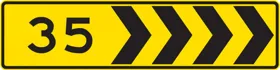
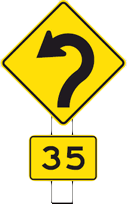
Yellow advisory speed signs indicate a recommended speed for the road feature ahead. They are not a speed target or guarantee - slow down further when road, weather, visibility or traffic conditions require it.
- Adjust your speed, ride to the conditions and ride to your own ability.
- Have fit-to-use tyres installed, visit your local motorcycle store if you are unsure if your tyres are ok (purchased a used motorcycle etc).
- Don't out-ride your vanishing point. The vanishing point is the maximum line of sight distance seen between you and any obstruction in your path of travel (ie vehicles, buildings, walls, hedges etc), this is the free space available for braking tasks when needed.
- There are no races to win when you are starting out your motorcycle self-discovery path as a new rider.
Check tyre pressures regularly
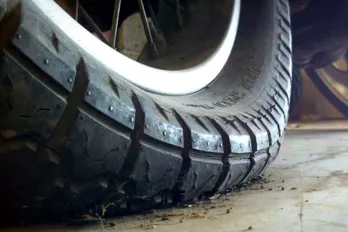
Tyres naturally lose some air pressure over time, and temperature changes also affect measured pressure.
Check your tyre pressures regularly and particularly before longer rides.
If a tyre repeatedly loses a noticeable amount of pressure, have the tyre, valve and wheel checked.
Correct pressure lets the tyre operate in the shape and load range intended by the motorcycle manufacturer.
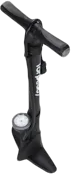
It is best to use a screw-on tyre pump as there is less stress on the tyre valve and many screw-on tyre pumps can fit much easier onto motorcycle tyre valves due to the funny angles needed to reach the motorcycle tyre valve and attach the air pump as the brake rotors can get in the way when using garage station air pump typically used on car tyres!
Car pumps and bicycle pumps are easy to find but getting a battery pump like the Xiaomi Tyre Pump with a measurement gauge and screw-on valve hose is much simpler to use and easy to carry in a bag or under seat storage.

What is the correct air pressure for my motorcycle tyres?
If you do not know this information, visit a motorcycle shop or ask a trusted friend to assist you.
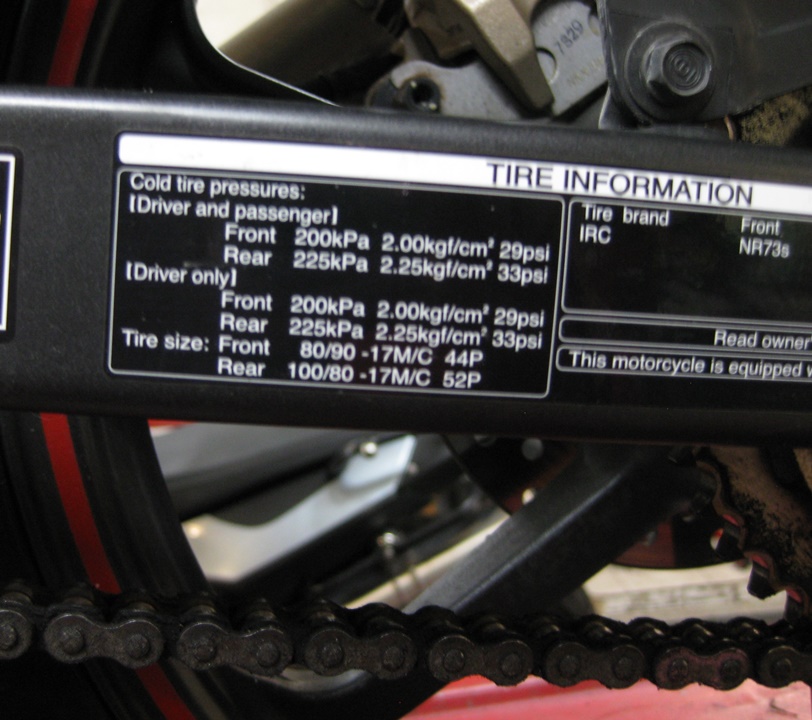
The swing-arm label or maintenance guide shows the tyre pressures for your motorcycle's maximum loading capacity ie with added luggage or pillion passenger.
Some examples of tyre pressures, not a guide.
36PSI front tyre and 42PSI rear tyre - 240KG touring motorcycle
36PSI front tyre and 36PSI rear tyre - 190KG sports motorcycle
25PSI front tyre and 28PSI rear tyre - 170KG classic cafe motorcycle
The correct pressure is specified for the motorcycle—not simply the tyre fitted to it.
A different motorcycle may have the same tyre make and model installed but the air pressures chosen are for that specific motorcycle and not the tyre itself. Pressures affect rider comfort, suspension and brakes.
Never over inflate your tyres beyond the motorcycle's recommended pressure guide!
Incorrect tyre pressure changes the shape and behaviour of the tyre and can affect steering, stability, braking, comfort, tyre wear and available grip.
Use the motorcycle manufacturer's recommended tyre pressures.
Understanding lean angle
Think of the curved motorcycle tyre as having a "rubber differential" effect.
When the motorcycle is upright and travelling straight ahead, it rolls mainly on the centre of the tyre, with the tyre's contact patch centred around the tyre's largest rolling radius.
When the motorcycle leans, the contact patch moves down the tyre's curved profile towards the sidewall. Across this contact area, the part nearer the centre of the tyre has a larger effective rolling radius, while the part farther down the curved profile has a smaller effective rolling radius.
The larger radius wants to travel farther with each tyre revolution than the smaller radius. This difference in effective rolling radius contributes to the tyre generating a cornering force towards the leaned side — somewhat like a flexible "rubber differential".
As the rider applies a counter-steering input, the motorcycle leans into the turn. Additional counter-steering input increases the motorcycle lean angle further and the contact patch moves farther down the tyre's curved profile. Together with the motorcycle's steering geometry, speed and the forces generated by the tyres, this allows the motorcycle to follow a tighter turning radius.
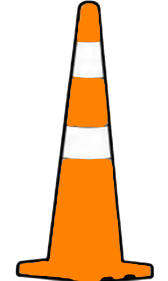
A cone provides an exaggerated demonstration of this effect. The large end of a cone travels farther with each revolution than the small end, causing the cone to naturally follow a curved path rather than rolling straight ahead.
Technical note
Countersteering is the primary practical steering input used to initiate and change motorcycle lean at normal riding speeds.
A motorcycle tyre is flexible rather than a rigid cone. The contact patch continually deforms as the tyre rolls, and motorcycle cornering involves camber thrust, slip angle, steering geometry and other tyre forces. The "rubber differential" is therefore a simple way of visualising the effect of the tyre's changing rolling radius — not a complete model of motorcycle cornering.

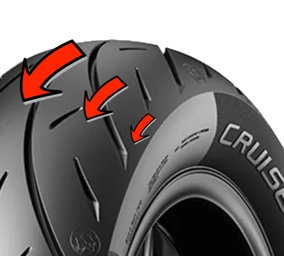
How much lean angle is available?
The amount of tyre profile used is directly related to the speed you are travelling at through any corner radius (how tight a corner is).
Normal road riding uses only part of the capability available from a suitable, roadworthy motorcycle tyre. You don't need extreme lean angles to ride normal roads confidently.
If you choose to go a little slower, less lean angle is required to complete the corner.
If you go faster, you will need more lean angle to complete the same corner.
On motorcycles fitted with footpeg feelers, they may touch the road as available ground clearance reduces producing a sharp scraping sound. This is a warning that parts of the motorcycle are approaching their ground-clearance limits - it is not a measure of how much tyre grip remains but are a good indicator the tyre side wall will also be close to it's design limit also.
Not every rider has the same state of mind, or has same motorcycle model but the same the physics we all depend to go down a road will apply to all riders and their motorcycles.
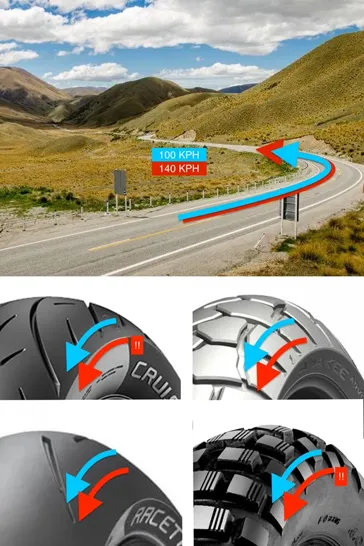
Below are some samples of recommended speeds are shown in blue arrows vs hot or aggressive riding shown with red arrows, the difference in tyre types shown have their own limitations of corner speed and lean angle but typically they match the motorcycle they are fitted too.
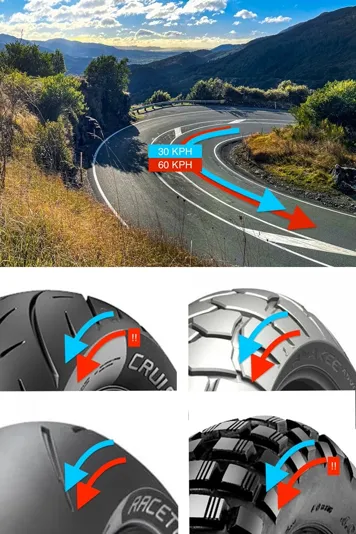
The selection of tyres shown range from sports to off-road
The blue overlay shows a typical or safe speed.
The red overlay would be the excessive speed choice for the same road example.
Note where “!!” is shown in red on the tyre profiles shown
Expect your foot peg feelers to scrape loudly before you exceed the tyre’s tread/grip area.
If you are scraping foot pegs mid corner, you may not be able to complete the corner on your side of the road if the corner tightens up more and you may fall victim to rider survival reactions which can make things worse (running wide, aggressive braking or throttle chop etc).
If you wish to learn more about your own limitations and rider ability, enrol for some track time with a motorcycle school near you - A much safer place to learn more about yourself, your motorcycle and have some fun without other vehicles coming towards you!