Some motorcycles improve learning, and others slow or restrict learning.
Looking at motorcyles
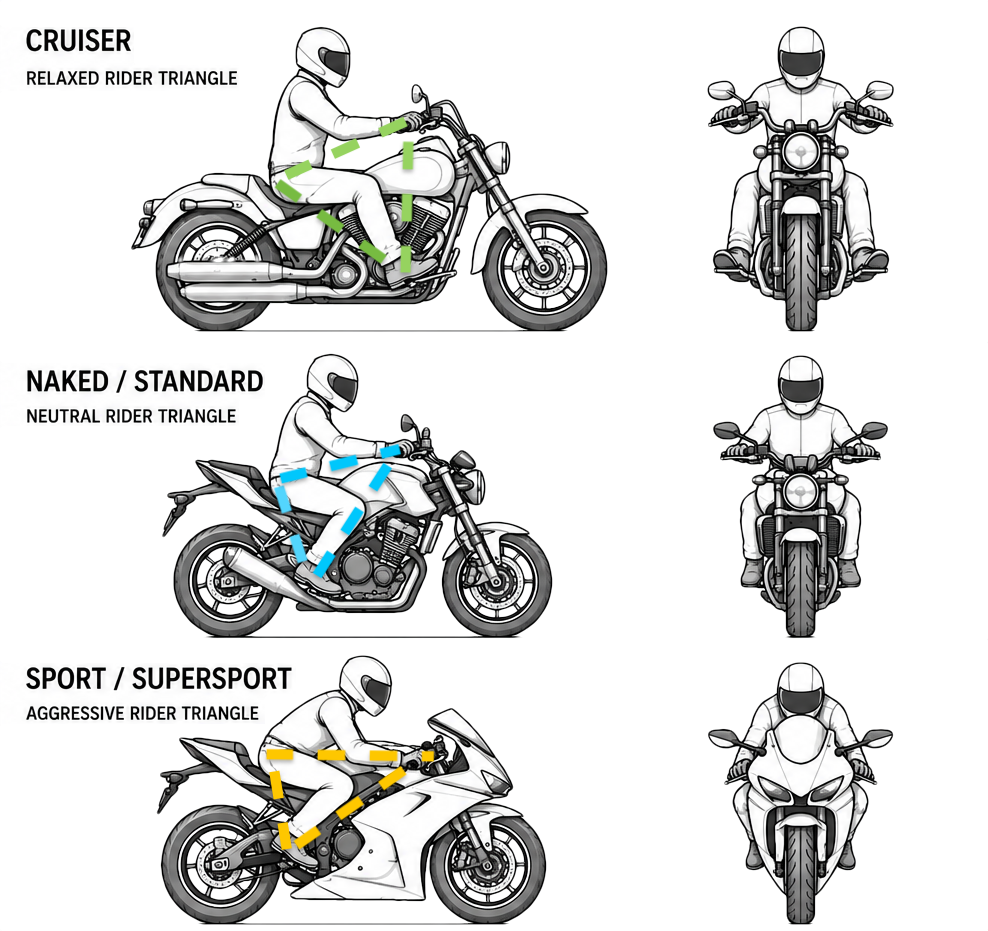
The rider's seating position, also known as the "rider triangle" as shown in the image below, is what really makes the difference for beginner riders when choosing a first motorcycle.
The sports rider triangle (shown with yellow dashed lines) is not the ideal rider position for beginner riders as the rider's position does not allow the body to relax. An aggressive rider triangle also causes rider fatigue sooner on each journey and can significantly slow a rider's learning as a side effect of sore wrists, a sore back, or mental fatigue.
Beginner riders need time learning and managing items like road position and situational awareness. These tasks are much easier to absorb and learn when you are comfortable while riding a motorcycle.
!! You can always upgrade your motorcycle later once your confidence and riding ability have improved.
Choosing your first motorcycle
A really good motorcycle to learn on will have a mostly upright rider position.
The rider's arms should have a relaxed reach to the handlebar grips without putting unnecessary pressure on the wrists.
These motorcycle models will be labelled as "Cruiser", "Naked" or "Standard" and shown with the green and blue rider triangles in the diagram. Most NZ LAMS-approved motorcycles will have a reasonable handlebar height to assist with rider comfort.
However, some LAMS bikes are basically lightweight sport bikes. Some examples include KTM's RC200 and RC390 where the rider triangle (triangle = foot, hip and hand positions) will have acute angles creating sore wrists and backs for learner riders.
There is nothing wrong with wanting to learn on this style of motorcycle, but your first motorcycle should have a favourable rider position (rider triangle) that allows you to relax and allowing more rider capacity to focus on good motorcycle control and rider awareness.
Back and wrist pain will actually prevent new riders from progressing with learning to ride effectively and even reduce the amount of riding time available to learn on two wheels so you can pass your licence assessments.
Choose a motorcycle you can grow with on your learning journey
You can expect to have two "first" motorcycles
- The one you really learn on, possibly a budget-focused purchase, on which you obtain your licences.
- The one you really wanted, might be a little larger, shinier, and cost a bit more.
Many experienced riders often return to small motorcycles to enjoy the simplicity of riding two wheels, you can use the whole motorcycle and not a small percentage of a larger motorcycle's potential. Gears, throttle, brakes and tyres all get used properly.
- Small motorcycles are genuinely cool, you will remember your first motorcycle and it will make an impression on you.
- Smaller motorcycles are easier to move around than larger bikes in city and urban environments. This adds to the fun factor and a very big part of riding a motorcycle is cornering aka the twisties!
- Typically a 125cc motorcycle is only ridden a few thousand km before being sold to the next learner rider looking for their first purchase. Reason being, they are good to learn on but are just a little too small to progress with modern-day traffic or maintain open road speeds. You may want more comfort offered by a slightly larger motorcycle (see 4. below).
- Moto Basics generally recommends starting with a manageable LAMS motorcycle, often in roughly the 200–400cc range. A 500cc motorcycle can potentially be more beginner-friendly than an awkward or aggressive 300cc machine. Weight, seat height, throttle response, ergonomics, power delivery and rider fit all matter when choosing your motorcycle.
- LAMS motorcycles are actually really good everyday motorcycles for any rider irrespective of licence class.
- LAMS motorcycles have a better resale value (if maintained well).
The "Top Speed" should never be the focus for your first motorcycle when you are reviewing your purchase options, however a motorcycle with some spare power capacity can handle a hill climb more easily, carry some luggage, and be able to reach 110-120 km/h when needed.
!! Headwinds, hills, luggage and other items will slow the smaller capacity motorcycles.