Rider's positional focus map
Let's get started.
How do we allocate our time correctly for what matters the most while riding?
Below is a map of our attention. We can only effectively concentrate on a few things at once, so let's explore how we can use this to simplify our priorities as a rider.
While the content explained may be obvious to some, many riders are missing basic awareness, so this article is intended to assist riders who may not be aware of their situation or unfolding events around them.
This article focuses mainly on mapping positional focus in traffic.
However, the same principles apply on open roads and how the vanishing point ultimately determines a "fit for scenario" speed choice and resulting vehicle lane position.
- Can you see around the corner at the speed you are traveling at?
- Can you see past other vehicles ahead?
- Can you see cars entering from side roads?
- Can you see cars crossing through a gap in a queue of congested vehicles?
- Could you safely come to a complete stop if needed for any situation?
Vanishing point guide reference: https://motobasics.nz/knowledgebase-articles/guides/guide-vanishing-point/
Orange zone focus area
The depth of this zone is defined by your vanishing point and affects tasks requiring immediate action, such as stopping, progressing and controlling the motorcycle.
Orange zone focus needed?
Focus in the orange zone is high but typically for short bursts of concentration, such as speed management and tasks directly ahead of the vehicle.
Orange zone task completion rate?
Must complete all tasks 100% when required.
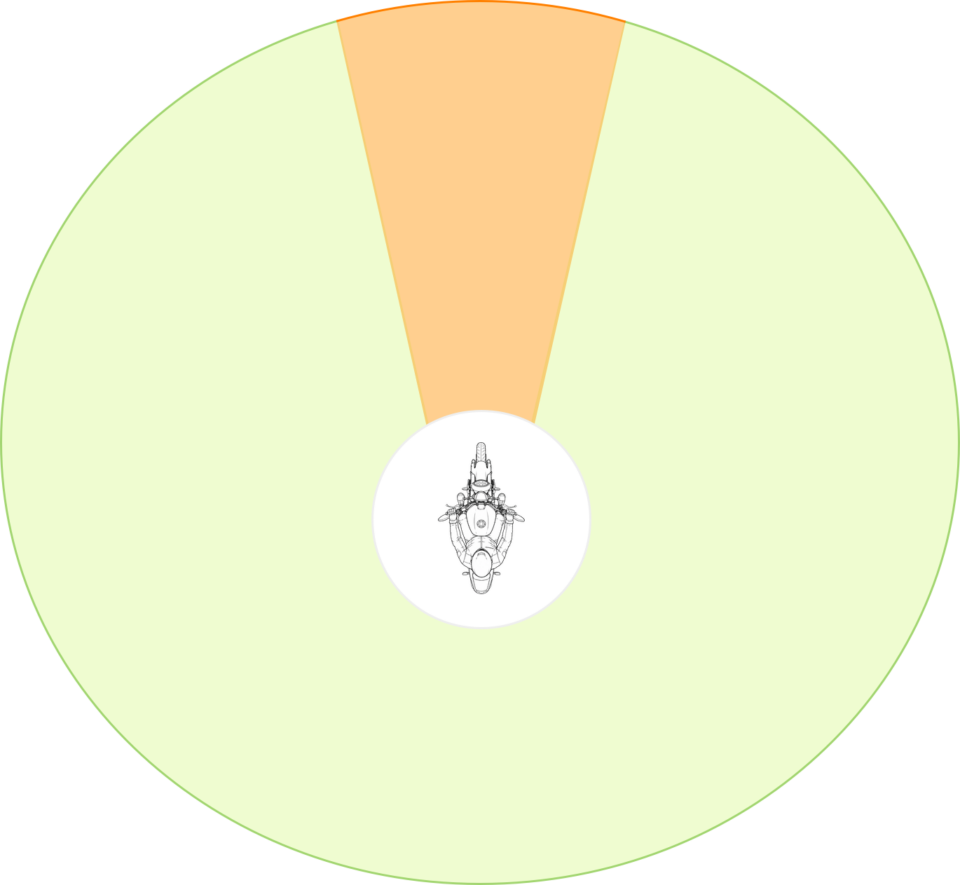
Green zone
Scanning the road ahead including intersections & driveways, mirror checks, and planning and making early decisions about situations you observe.
Green zone focus needed?
Focus on green zone tasks reduces while managing tasks in the orange zone.
Green zone task completion?
Use free time not used on orange tasks to scan roadsides, intersections, check mirrors, identify developing situations and plan ahead.
Progressing with traffic
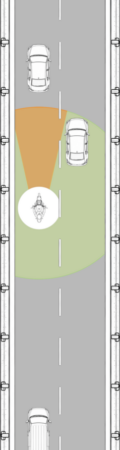
Correct following distance has benefits.
When you maintain a good space buffer ahead of your motorcycle, less attention is required for immediate speed and braking adjustments. This leaves more time to scan your surroundings, check your mirrors and maintain situational awareness.
As you get closer to vehicles or objects that are ahead of you in the orange zone, the amount of your attention shifts into the orange zone to manage your speed and controls more. Attention to situational tasks in the green zone slows or decreases. This is normal!
By keeping a safe following distance, you actually gain more positional awareness from your green zone tasks and that feeds back into the orange zone task completion.
A direct result of having an adequate following distance using the 2–4-second following rule is that you have time to do regular mirror checks, and by scanning the road ahead you get a whole picture of your situation.
You are also keeping time available to react to any events that may require braking or evasive action. The green zone tasks greatly contribute to orange zone reactions and task completion. If you know what’s happening, you can act sooner.
You must progress with traffic!
There is no need to slow unnecessarily beyond the 2–4-second following rule, as slowing traffic behind you without turn signals or genuine purpose could be met with aggression, rudeness and risky overtaking manoeuvres towards the motorcycle rider.
Following too close consumes your attention
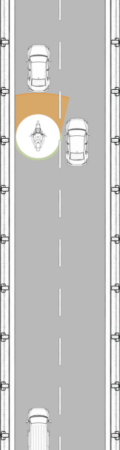
See how the distance of the orange zone has shortened?
This is the braking space you have left. As that space decreases, you have less time to recognise and respond to changes in the vehicle ahead.
One slight change in speed from the vehicle in front means you may miss that vehicle slowing if you are looking elsewhere at the exact moment it occurs.
Following too closely — ‘tailgating’
As your following distance decreases, more of your attention is required to monitor small speed changes from the vehicle immediately ahead. This leaves less time to scan mirrors, intersections, traffic gaps and vehicles farther ahead.
Bad habits include following too closely to other vehicles ahead. You have essentially arrived at your vanishing point and, as a result, have removed most of your safe braking zone when needed.
Tailgating another vehicle is not related to lane sharing as you are without a clear path to proceed or brake!
A safe following distance is far more relaxing!
By having an adequate following distance, you are more relaxed, can see beyond that one vehicle you are following and this contributes to a happier ride on two wheels. (It’s not just about safety!)
Speeding
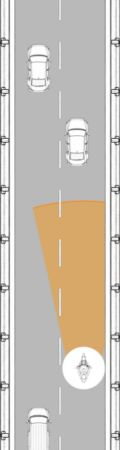
Tunnel vision and the speed delta.
The orange zone is now shown as extending farther ahead, as travelling at a higher speed than the surrounding traffic (known as the speed delta) assumes that you have the braking distance to support that speed if you need to stop quickly, regardless of whether that speed is legal.
The focus required in the orange zone takes priority due to the speed delta as you are approaching vehicles instead of maintaining a safe following distance.
As your speed or speed difference increases, more attention is required for the immediate tasks in the orange zone. This leaves less time available for green-zone tasks such as checking mirrors, scanning intersections and observing developing situations around you.
Read more about traffic survival and the speed delta: https://motobasics.nz/knowledgebase-articles/guides/guide-motorcycle-on-road-survival-guide-traffic-safety/
Bad habit, excess speed!
You are no longer observing your mirrors regularly, and potentially unaware of what any other vehicles are doing as a direct result of a large speed delta.
Don’t expect any other vehicles to know how fast you are traveling and don’t expect them to adjust their vehicle for your action or choice to speed excessively.
Excess speed makes life harder.
Any vehicle can speed, but the motorcycle rider hurts a lot more if they contact a vehicle that has crossed their path of travel.
Other road users expect other vehicles to be traveling or progressing at similar speeds to the surrounding traffic so they can merge safely.
Just remember, some vehicles have pets, children and elderly folk; all of these vehicles progress normally as it is uncomfortable having the passengers falling out of their car seats with aggressive acceleration or braking.
Overview of rider focus
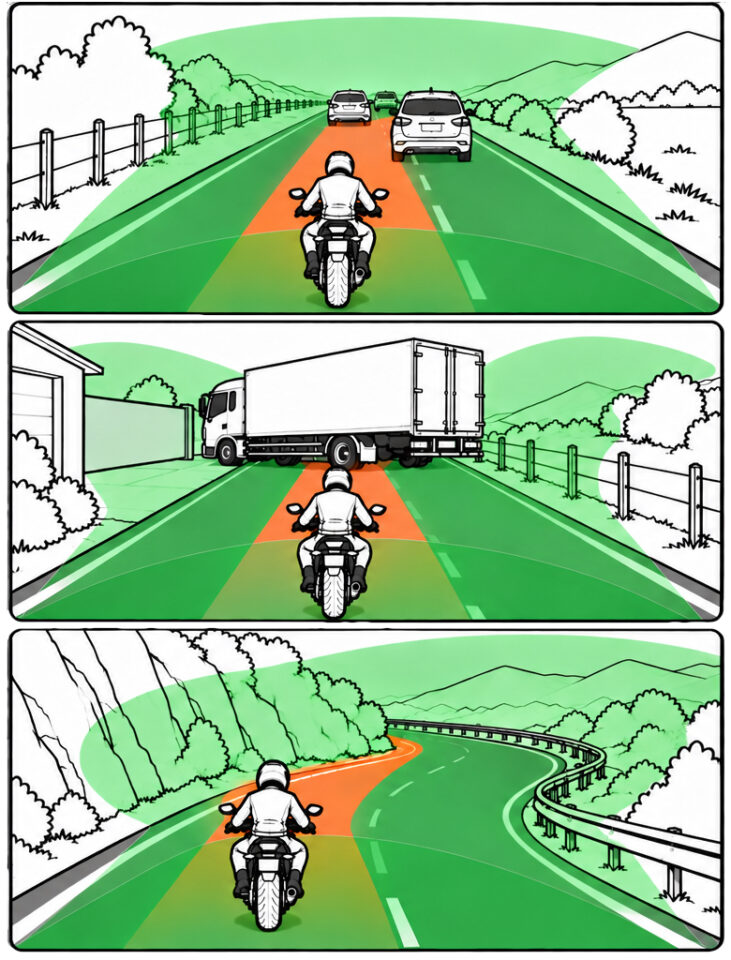
Understanding your vanishing point, it's linked to the focus tasks needed for the orange zone!
Anything that obscures your line of sight to your intended path of travel, that is your vanishing point.
- It tells you there is a change ahead, prepare;
- It defines your braking area if you need to slow or come to a complete stop;
- It doesn't tell you if vehicles behind you are aware and have adjusted to the same situation (green zone task);
- It doesn't tell you what is beyond the vanishing point, with a safe speed or action you will eventually see past the current obstruction without any surprises.
The faster you travel, the less time you have to obtain information and then take action for the situation ahead.
Remember, the vanishing point is always moving ahead to the next road feature as you progress forward.
If you carry too much speed for any situation you may not be able to safely update your awareness of the situation ahead, or reposition your motorcycle easily for other road users who may not be in the correct position themselves!
If you approach your vanishing point with excess speed!
- A corner may tighten beyond your line of sight, vehicle control errors may arise;
- People or vehicles previously obscured beyond your line of sight appear suddenly;
- Leaving the lane, running off the road or colliding with other vehicles
- Tunnel vision or target fixation can occur;
- Less situational awareness due to attention focused on the immediate path of travel.
See how the image depicts vehicle speed and a focus on the orange zone ahead without any green zone showing?
With excessive speed, these green zone focus tasks reduce significantly.
- Observing side streets, intersections and commercial premises where vehicles could enter your lane;
- Observing vehicles possibly following behind you;
- Giving information to other vehicles about your intentions including turn signals, brake lights, etc in a fair and predictable way.
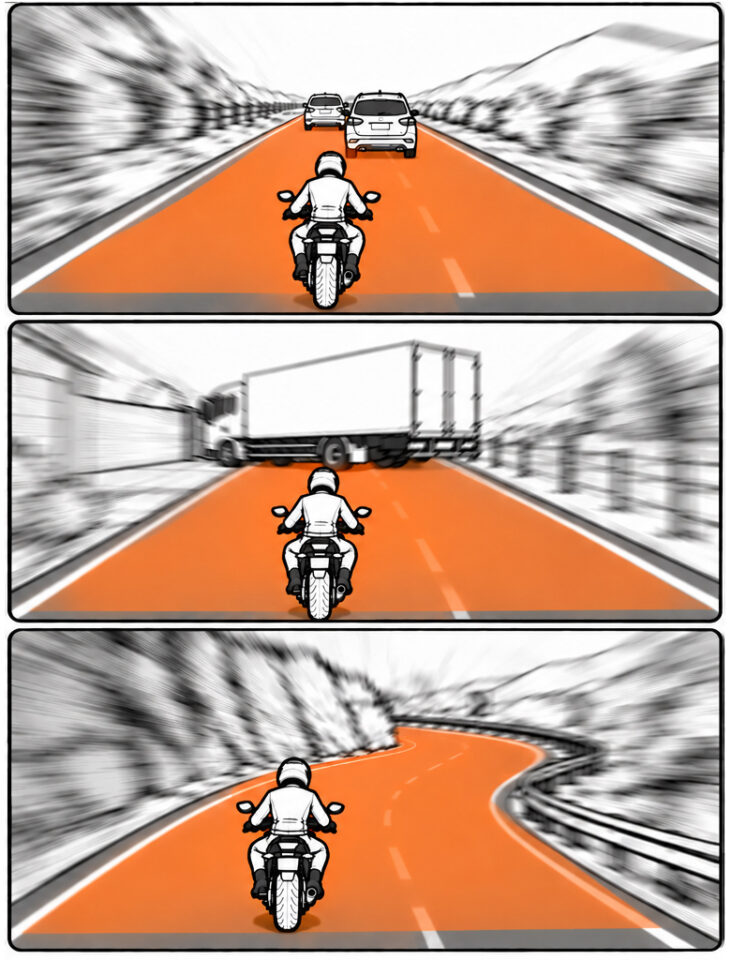
When you ride without any safety buffer beyond the vanishing point information observed, this is known as outriding your vanishing point.
Riding in complete darkness is one example that demonstrates how you can outride your vanishing point.
While riding in complete darkness, the vanishing point is usually the edge of your own headlamp's light throw, which is typically a much shorter distance than what can be seen during daylight. You have to reduce your speed, as road features can suddenly appear within the limited visibility. Otherwise, you may outride your line of sight—the vanishing point.
Remember, your available braking distance is defined by the vanishing point you can observe. If you are outriding your vanishing point, you may not have enough visible distance to brake safely.
Many motorcycle incidents involving other vehicles can be avoided through good awareness, positioning and appropriate speed choices around traffic.