BHST = Basic Handling Skills Test
Once you have reasonable control of a motorcycle, it is time to pass the BHST.
If you can confidently do all of these:
- Have good control of the motorcycle's throttle and clutch;
- Understand how to use the brakes smoothly and perform an emergency stop;
- Know how to perform a U-turn and figure eights;
- Know how to park a motorcycle;
- Know how to perform a head check (lifesaver check);
- Use turn signals correctly.
Book some practice time, and with good motorcycle control and careful attention to the assessor's instructions, you can work towards passing the BHST and obtaining your riding certificate.
The actual BHST assessment itself is only 5-10mins long. See demonstration videos in the guides section.
Access the free 6L & BHST guides
This website and the material found here is designed to give new riders the chance to absorb and retain relevant information for their own "learning to ride journey".
The items here should be used before and after a physical motorcycle session whether that motorcycle session is with a friend, a parent or a motorcycle school near you.
The complete index for guides can be found here: https://motobasics.nz/knowledgebase-articles
Professional motorcycle training is extremely valuable, but instructor time has an unavoidable cost. Moto Basics makes the preparatory learning material freely available so riders can use paid training time more effectively.
The process for obtaining your motorcycle 6L learners licence:
Step 1. Pass the BHST riding assessment.
Step 2. Pass the road code test on a separate day (and a vision test).
You must pass your BHST assessment and obtain your riding certificate before taking the road code test.
The road code test, you must pass 32 out of 35 questions, and 5 questions will be motorcycle specific questions.
See the guides below "Road code testing - JT free practice online #205" to learn all the questions that could be asked in the road code test - things like speed limits when towing a trailer, carry load overhang distance are actual questions for motorcycle road code tests!
Use this free online testing tool once a day for 30 min over a week to sharpen your road code knowledge.
6L & BHST guides
Moto Basics BHST demo #201:
Cars N Bikes BHST demo #202:
NZTA BHST demo #203:
Moto Basics make your own BHST course #204:
Road code testing - JT free practice online #205:
NZTA BHST information #206:
NZTA road code information #207:
** Once you pass your BHST assessment and road code testing (Congratulations if you have obtained your 6L licence!), please note that mirrors and road scanning is not currently part of the BHST assessment process but is vitally important you understand how to do mirror checks and road scanning once you are riding on public roads.
Mirror, head-checks and road scanning #402, see general guides section.
Practising the BHST (6L)
The BHST is a good learning tool for new motorcycle riders and can be incorporated as part of basic learning but you will not pass the BHST assessment without safe motorcycle control.
Moto Basics recommends that you spend preparatory time on two wheels to understand your controls to be safe and ready before attempting the BHST assessment. From the guides, see video demonstrations YouTube #201 and YouTube #202
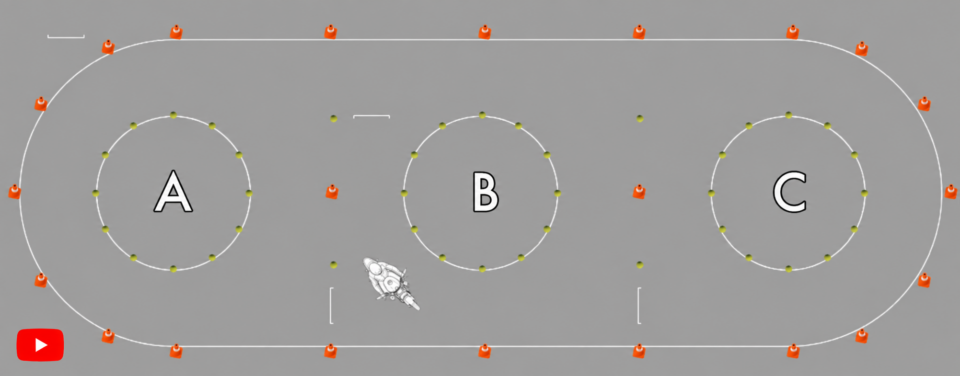
Practice the BHST assessment using three (3) learning layers.
- 1. Just start with learning the BHST course’s four (4) stages and this includes lane positioning, control management, corners, turn-back/parking, stopping normally and an emergency stop.
- 2. Once confident riding the 4 stages, now re-do the 4 stages adding head checks till confident.
- 3. Add indicators on and off where required, now re-do the 4 stages using head checks and indicators till confident.
!! Always be looking where you need to go and not be staring at your controls or your front wheel !!
New riders will find all the little steps rushed at first, if you relax and don't rush this practice you will eventually realise you're only doing one thing at any point during the assessment, example: indicating, a head check. then a corner, then indicator off, then stopping.
It’s all just a sequence of tasks you are preparing for that will occur in real world scenarios and all these actions are part of your licence obligations when sharing the road with other road users. T.U.G = Take in information, Use information, Give (communicate) information.
After obtaining your 6L motorcycle licence
Once you obtain your licence it is important to keep learning your motorcycle road craft as you need to deal with real-life situations when riding.
Start working towards your restricted 6R licence requirements so you gain good habits and keep learning at the same time: https://motobasics.nz/motorcycle-6r-6f-assessment
Things you can now do with a motorcycle licence
- Insure a motorcycle for public road use;
- You may choose to use finance services to buy a motorcycle;
- You can ride any LAMS approved motorcycle between 5am and 10pm (LAMS = Learner Approved Motorcycle Scheme).
Looking to buy a motorcycle? See: https://motobasics.nz/knowledgebase-articles/guides/guide-buy-a-motorcycle-for-learner-rider
NZTA guidelines for the BHST
You may use use any LAMS approved motorcycle in the BHST assessment.
NZTA excludes certain vehicles from being used during a Basic Handling Skills Test.
- Any three wheeled vehicle, eg Tricity;
- A motorcycle that is not LAMS compliant;
- A moped;
- An all-terrain vehicle;
- Motorcycles such as pitbikes, minibikes, paddock bikes, junior sized motorcycles.
Additionally, while the test itself is not performed on public streets, the motorcycle must be road worthy for the Basic Handling Skills Test.
See official NZTA document here: https://www.nzta.govt.nz/assets/resources/basic-handling-skills-test-manual/docs/basic-handling-skills-test-manual.pdf